
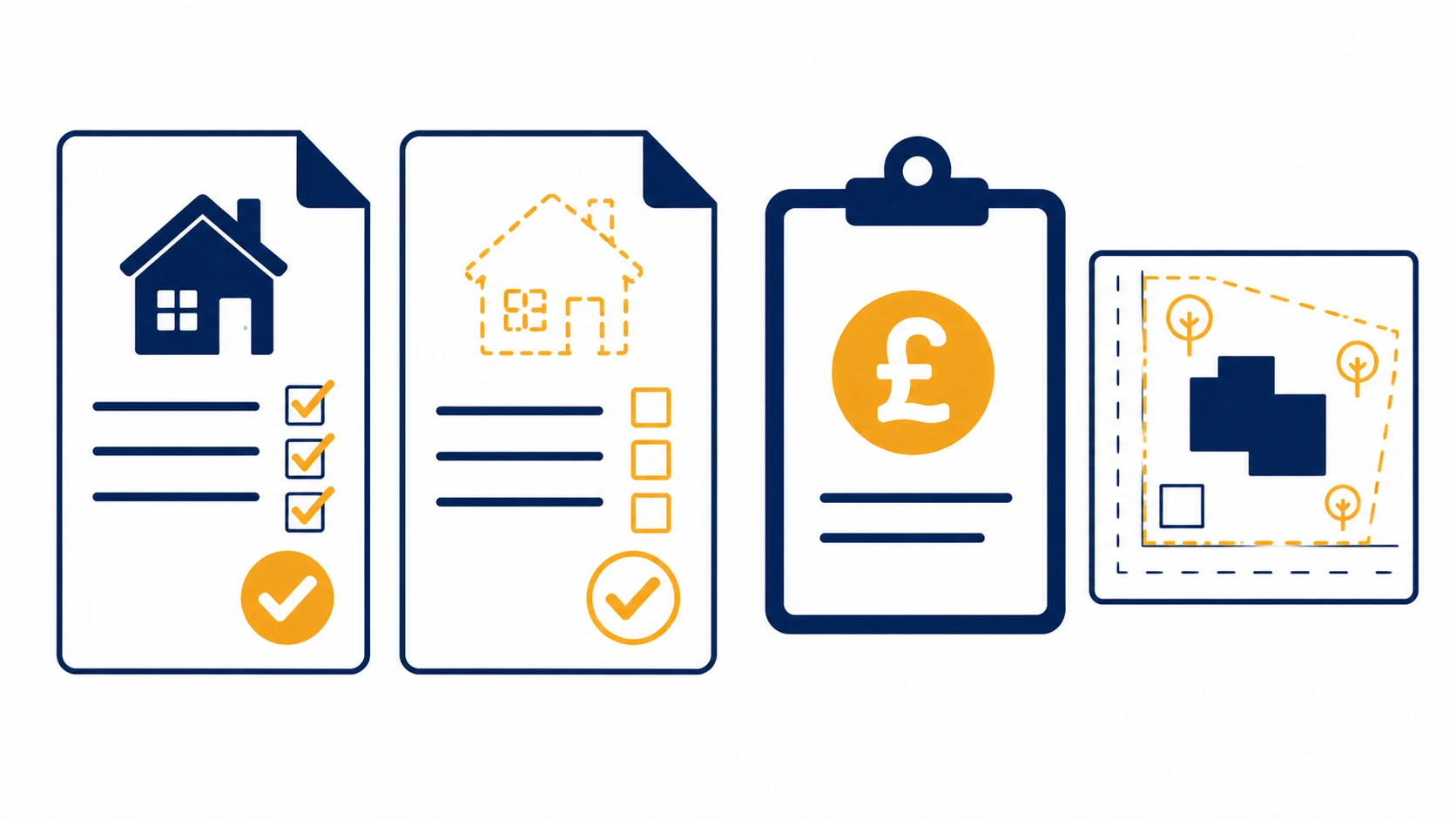
Two developers can submit what looks like the same project and end up paying through completely different fee structures, simply because one chose outline permission first and the other went straight to a full application. Full is priced per dwelling or by floorspace. Outline is priced by site area entirely, with no reference to dwelling count at all. Understanding which route actually suits a project matters more than most guides suggest, because the choice affects far more than just the number on the invoice.
What a full application actually covers
Everything goes in at once: design, layout, materials, access, landscaping. Once granted, subject to any attached conditions, building can generally start without a further application. The fee reflects the full scope of what’s being assessed:
- 1 to 9 dwellings: £610 per dwelling
- 10 to 50 dwellings: £659 per dwelling
- Over 50 dwellings: £32,578, plus £196 per dwelling above 50, capped at £427,537
For non-residential schemes, the equivalent structure is charged per 75 square metres of floorspace rather than per dwelling.
What an outline application asks instead
Outline permission answers a narrower question: is development acceptable here in principle, before any detailed design work has been commissioned? Some or all of the detailed matters, access, appearance, landscaping, layout, and scale, can be reserved for a later stage rather than settled upfront.
Because there’s no detailed scheme to assess yet, the fee is calculated differently, using site area instead of dwelling count:
- Under 0.5 hectares: £610 per 0.1 hectare
- 0.5 to 2.5 hectares: £659 per 0.1 hectare
- Over 2.5 hectares: £16,291, plus £196 per 0.1 hectare above 2.5, capped at £213,769
The follow-up stage nobody budgets for properly
Outline permission alone doesn’t let anyone start building. A Reserved Matters application still needs to be submitted afterward, working through the detailed design that outline permission deliberately left open. This isn’t a second full fee. If the full fee was already paid at outline stage, Reserved Matters is capped at £610, regardless of how large the scheme is.
Why this cap exists
The logic is straightforward once you see it: the council has already been paid, in effect, for assessing a scheme of this scale, at outline stage. Reserved Matters isn’t a new application in the same sense; it’s the second half of one application split across two decision points. Charging the full per-dwelling rate again would mean paying twice for assessing the same underlying scheme.
So why would anyone choose outline over full?
Rarely because it’s cheaper. Across both stages combined, the total often lands close to what a single full application would have cost anyway. The real reason developers choose outline first is risk.
A full application that gets refused has already cost real money on completed architectural drawings, access designs, and landscaping plans, none of which get refunded, all of it wasted on a scheme the council won’t approve. An outline application refused at the same stage has cost far less, because the expensive detailed design work was never commissioned in the first place. You find out whether the underlying idea is acceptable before spending on the details.
When this distinction barely matters
For a small, straightforward site with a cooperative planning authority, going straight to a full application is usually simpler and just as fast, with no meaningful risk reduction gained from splitting the process. The outline route earns its complexity mainly on larger, contested, or genuinely uncertain sites, where the possibility of refusal is real enough to be worth planning around.
A side-by-side worked example
A developer proposes 8 houses on a 0.4 hectare site.
Full application route: 8 dwellings × £610 = £4,880, paid once, covering the entire detailed scheme.
Outline-first route: the 0.4 hectare site falls entirely under the 0.5 hectare threshold, so 4 units of 0.1 hectare at £610 each comes to £2,440 at outline stage. Once granted, Reserved Matters is capped at £610 since the full fee was already paid. Combined total across both stages: £3,050.
In this particular case, splitting the application into two stages actually costs less overall, not just spreads the risk. That won’t always hold true. It depends heavily on how site area and dwelling count relate to each other on any given project, which is exactly the kind of comparison worth running properly rather than estimating.
How this fits with the rest of the application landscape
Full and outline both sit apart from a householder application, which covers extensions and alterations to a single existing house at a flat £548, regardless of size. If a project involves new dwellings rather than altering an existing one, it’s worth checking our new build house planning fee guide for how the per-dwelling banding plays out in more detail, or the total cost breakdown if drawings and service charges also need factoring in.
For the official guidance on choosing between outline and full applications, see Planning Portal. For the current fee schedule, see Gov.uk: Fees for planning applications.
Want the exact comparison for your own scheme rather than a general example? Use the calculator to run both routes side by side.